A Double Feature for Watching the Landscape Change
Pair two Westerns with contrasting landscapes and a handful of observation prompts to see how terrain shapes movement, mood, and screen character.
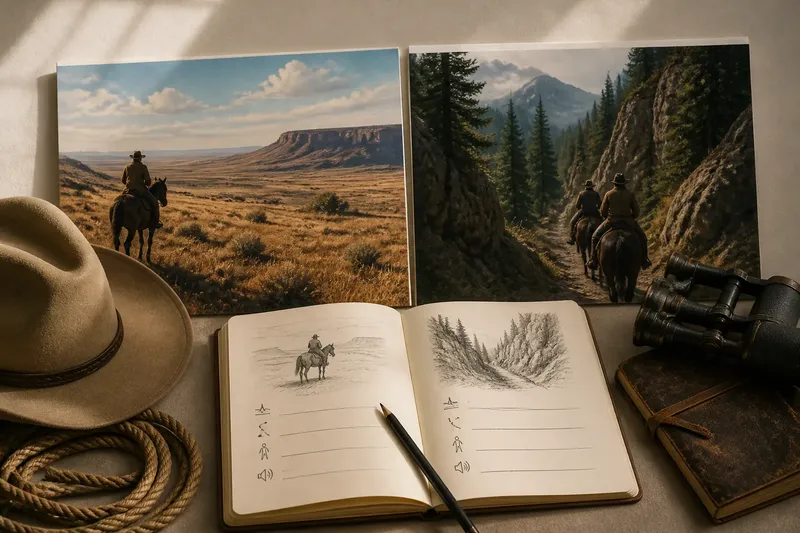
One Western puts a rider against an open horizon; another sends a small group through a narrow pass. A landscape double feature makes that contrast the evening’s subject, without requiring a lecture or a plot chart. Choose two films with visibly different terrain, then watch for what the ground asks of the people on screen.
The point is not to rank scenery or decide which film looks more “authentic.” It is to notice how a place organizes attention: where a character can go, what can be seen, and how much room the image gives a body. These five compact prompts keep the comparison close to what the screen shows.
1. Choose contrasting ground
Start with landscape, not reputation. Pair a film dominated by open plains, desert flats, or broad valleys with one shaped by forest, canyon, mountain, or tightly built terrain. The contrast should be easy to recognize even if you have never seen either film.
There is no need to find a perfect pair from the same period, director, or subgenre. In fact, a loose pairing can make differences in camera placement and performance easier to see. The useful condition is that both films give their settings enough screen time to function as more than a backdrop.
Pick films you can access without turning the evening into a research project. A familiar title can work beside an unfamiliar one; knowing the story of one film may even make you more alert to how its setting directs your eye. Avoid reading detailed plot summaries if you want the images to lead.
Write each landscape in a few plain words before watching: “wide and exposed” or “steep, wooded, and broken.” Keep that description provisional. The film may make a place feel different from what its geography suggests.
2. Watch the horizon
In the first film, notice how often the horizon appears and where it sits in the frame. A high horizon can leave more room for sky; a low one can make land seem to stretch outward. Neither choice has a fixed meaning. Look at what the characters are doing in that composition.
Does a rider cross the frame with open space ahead, or arrive from a distant edge? Does the camera hold still while a figure moves, or travel alongside? The horizon can give movement a destination, or make it seem as though the character is passing through a place too large to master.
In the second film, repeat the same observation rather than switching to a new theory. A canyon wall, ridge, or stand of trees may interrupt the long view. See whether the film replaces distant visibility with nearer obstacles, and whether characters pause, turn, or disappear behind them.
For a simple note, record one moment when a character becomes small in the landscape and one when the landscape seems to close around them. The contrast can reveal more than a general impression of “vast” or “claustrophobic.”
3. Follow the routes
Watch where people travel, not only where they arrive. Open ground may make a route legible from far away, while broken terrain can hide the path around a bend or behind a rise. A trail, river, road, or ridge can become a visual line that connects separated parts of the frame.
Notice who chooses the route and who follows it. A character who leads across a plain may appear exposed, while a guide moving through unfamiliar terrain can hold a different kind of authority. The film does not have to explain that relationship in dialogue; spacing and direction may already make it visible.
Say you pair a film set across open grassland with one built around a rocky pass. In the first, you might note that a rider’s route stays visible long after the figure becomes small. In the second, you might see the same kind of movement vanish around a bend. The expected observation is not that one place is safer, but that each film gives the viewer a different amount of access to the journey.
Keep route notes concrete: “the trail bends out of sight” is more useful than “the terrain feels mysterious.”
4. Notice bodies and objects
Landscape becomes part of character when it changes how a person occupies the frame. Look at posture, pace, and distance from other people. A rider may sit upright against a broad view, stoop beneath branches, or dismount where the ground turns difficult. These actions can make a character’s competence, fatigue, or caution legible without turning the setting into a personality test.
Pay attention to props as well. A horse, wagon, rifle, water container, or coat has a different visual weight in open space than among rocks or trees. Ask whether an object appears easy to carry, hard to maneuver, or conspicuous against its surroundings. The same costume can read differently when the background changes.
Then compare the performances. Does the actor move with the terrain, or seem deliberately at odds with it? Stillness may read as command in one composition and hesitation in another. Avoid assigning a single universal meaning; connect the gesture to the shot that contains it.
5. Compare sound and color
Land is not only what the camera shows. Listen for wind, hoofbeats, birds, water, or stretches of quiet. Sound can suggest distance beyond the frame, make a place feel inhabited, or leave a character exposed in silence. Notice whether the soundtrack continues across a cut or changes as the film moves between locations.
Color and texture deserve the same attention. Dust, grass, bare rock, snow, and foliage can separate a figure from the surroundings or blend them together. If you are watching on a small screen, do not strain to judge subtle color differences. Focus instead on clear contrasts in light, movement, and surface.
Ask whether the film presents the landscape as something to cross, a place to remain in, or a force that keeps interrupting human plans. The answer may shift from scene to scene. A quiet stretch of land can feel welcoming in one shot and indifferent in the next.
Questions for the pairing?
Do the Westerns need to be from the same era?
No. A difference in era may be part of what you notice, especially in framing, color, or how much the camera lingers on terrain. Keep the comparison focused on visible choices rather than treating one period as a single style.
What if both films use similar scenery?
Choose a different contrast within the setting, such as open ground against dense vegetation or a broad valley against a confined trail. If the images still feel alike, compare how each film places people and routes in the landscape.
Should I take notes while watching?
A few words after each film are enough. Jot down one horizon, one route, and one gesture that the terrain shaped; pausing during a scene is optional, not a requirement.
How do I avoid turning the pairing into a plot comparison?
Leave character arcs and endings aside for the evening. Use the prompts to compare frame, movement, sound, and the space between people and their surroundings.
A small closing note
When the films end, place the two landscape descriptions side by side and add one sentence about how each changed a character’s movement or visibility. That modest record is enough to make a Western landscape double feature worthwhile: next time a familiar rider crosses an open horizon, you may notice not only where the figure is going, but how the image lets you follow.