Showdown or Chase: Two Ways to Build a Western’s Tension
A Western showdown or chase builds tension through different uses of space, timing, and audience knowledge, helping viewers read danger before it arrives.
A rider reaches a dry creek crossing just as another figure appears on the ridge. In a Western showdown or chase, the same distance can hold a threat still or become ground to cross. A showdown asks us to watch for the first decisive move. A chase asks us to follow what happens after someone makes it.
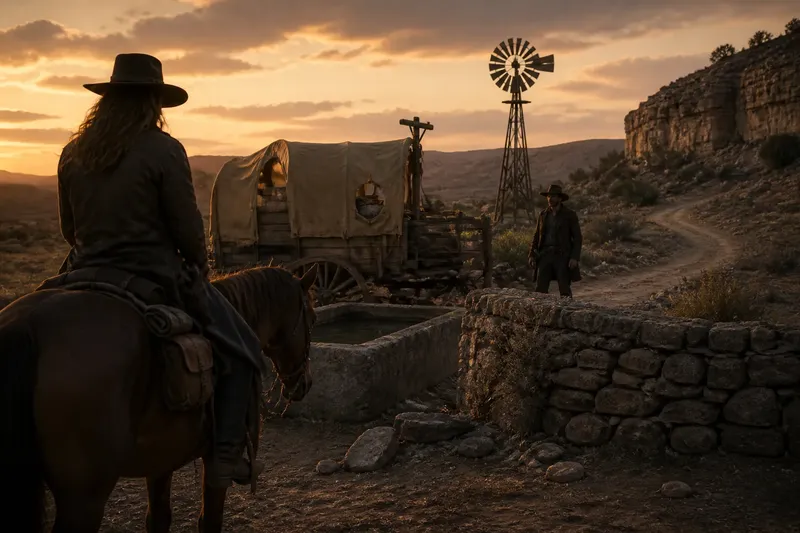
Imagine a fictional scene with Mara and Rusk at an abandoned water stop. A canvas packet caught in a wagon’s broken side rail contains a map they both want. A low stone wall offers cover, and a narrow track bends behind a shelf of rock. The conflict stays the same in each version; what changes is the way the film arranges our attention.
The Shared Situation
Mara arrives at dusk. Her horse is tired. Rusk stands beside the wagon, with the packet visible through a split in the canvas. Beyond the trough, a windmill turns unevenly. The track out of the basin gives either character a possible exit.
These details can shape either kind of scene. The wall might divide the characters or give one a place to wait. The track might become a route away or a danger just beyond view. The packet keeps the conflict visible. Their order and emphasis determine whether the scene feels held or in motion.
Keep the starting point fixed: both characters are present, both know the packet matters, and neither has made a decisive move. In the showdown version, they remain near the water stop. In the chase version, the first decisive action carries them away.
Showdown Tension
Mara stops at the edge of the basin. Rusk does not advance. A wide view places the stone wall, wagon, track, and both figures in one frame. The audience can study the distance between them and notice the possible routes out. The danger lies in a space that has not changed yet.
Closer views make small actions legible. A hand settles near a belt. A boot turns toward the track. Rusk glances at the windmill rather than at Mara. Each gesture matters because the scene has made us watch for a change in the arrangement.
Timing depends on postponement. The characters may speak, but they do not need to explain every motive. A pause after a question can shift attention from words to hands, shoulders, and open ground. The wait earns its place when its meaning changes: a character notices an exit, reconsiders a threat, or decides not to move.
The camera can also control how much the audience knows. If viewers have seen the packet but do not know whether Rusk is armed, they share Mara’s uncertainty. If the frame has revealed someone behind the wall, viewers know more than she does and wait for the hidden danger to enter her awareness.
Sound can keep the scene alert without explaining how to feel. A creaking windmill, leather shifting, or a horse stamping once gives the quiet texture. A sudden clatter can matter because the scene has taught us to listen.
For a showdown, make the pause change meaning rather than merely grow longer.
Chase Geography
Now Rusk grabs the packet and runs toward the narrow track. Mara mounts and follows. The water stop recedes, and the scene’s question shifts from who will move to whether Mara can close the distance before the track bends out of sight.
A chase gives suspense a moving target. Viewers must follow the riders, the terrain, and the route ahead. The rock shelf can hide Rusk briefly. A shallow wash can slow Mara. The bend can conceal what lies next. Each landmark changes what the characters can do and what the audience can see.
Shot order controls that knowledge. A view behind Mara might show Rusk’s horse slipping on loose ground, giving viewers reason to expect a delay. A view beside Rusk might reveal a turnoff Mara cannot yet see. Cutting between the riders lets the audience compare their positions; staying with one rider limits that knowledge and can make the next turn surprising.
Speed by itself does not make a chase clear or compelling. If the riders cross open ground in repeated distant views, the action may become hard to read. The landscape should alter the available choices: a narrowing track, a fence in the way, or a fork in the road. An obstacle matters when it affects what a character can do.
Movement also makes decisions visible. Rusk turns left, and Mara must choose whether to follow or risk losing sight of him. She might protect her horse, pursue the packet, or avoid a route she suspects is a trap. The choice can be quick and still reveal her priorities.
A chase can pause when one rider vanishes behind a bluff. The other must guess which route to take. The uncertainty resembles a showdown, but the expectation of renewed movement gives it a direction.
Give every turn a consequence. A change of scenery alone does not change the pursuit.
Audience Knowledge
The distinction is not simply whether the characters stand or run. A face-off often lets viewers study a contained arrangement and wonder which possibility will happen. A chase asks them to update their understanding as people and landmarks move in and out of view.
Imagine Mara sees Rusk glance toward the bend but does not know why. In a showdown, that glance can hang in the air: is he planning to flee, signal someone, or check the route? In a chase, the same glance may signal an immediate choice. Rusk takes the bend, and Mara must respond before the opening disappears.
Information can reverse the usual advantage. Suppose the audience has already seen that the track ends at a collapsed bridge. A pursuit toward it can build dread because viewers know the danger before Mara does. In a face-off, the audience might see Rusk notice the bridge and wonder whether he means to lure her there.
Uncertainty works best when it comes from a character’s limited view, a deliberate framing choice, or a meaningful delay. Hiding an obvious route only to reveal it later can feel arbitrary. Let viewers see enough to form a question, even when they cannot yet answer it.
Questions About Form?
What makes a Western showdown tense?
A showdown becomes tense when viewers can read the space but cannot predict which possible action will happen. Distance, stillness, and small changes in posture make a pause consequential.
How does a chase keep viewers oriented?
Recurring landmarks and clear directions help viewers understand where each rider is going. Cuts can vary the view while preserving enough geography to make the choices legible.
Can a chase include a standoff?
Yes. A rider may lose sight of the other at a bend, then stop at a fork and listen before choosing a route. The suspended decision borrows from a face-off while the pursuit’s objective remains in place.
Can a showdown become a chase?
Yes. One character might reach for the packet, cross the open ground, or turn toward a horse. A specific action breaks the held arrangement and gives the audience a new pressure to follow.
Scene Decisions
For the imagined water-stop scene, compare what each version asks viewers to do. The showdown asks them to inspect a stable space and interpret small changes. The chase asks them to track shifting positions and predict how terrain will constrain the next move. Neither form is automatically more intense; each needs to prepare the audience for the kind of attention it requires.
Consider how the packet stays visible. In the face-off, its place in the wagon can keep the conflict present while the characters delay. In the chase, it might flutter from the canvas or remain in Rusk’s hand, giving viewers a visual thread to follow. The object can carry the reminder without repeated explanation.
Consider what each character knows. If Mara knows the land and Rusk does not, a chase through familiar terrain may let her choose routes with confidence. If Rusk has the faster horse but Mara knows about a hidden fork, the pursuit can turn on knowledge rather than speed. In a face-off, those differences might appear in where each person stands and which exits they watch.
Imagine Mara’s horse is tired, Rusk has taken the packet, and the track forks beyond the rock shelf. The filmmaker first holds on both characters by the wagon, letting viewers see the fork’s direction but not what lies beyond it. Rusk then runs for the left branch. Mara mounts, but the horse hesitates on loose ground. She sees the dust from Rusk’s turn and chooses the right branch, where a shallow wash could carry her back toward the track. The result is a chase with a clear tradeoff: Mara gives up the most direct route to avoid pushing her horse over unstable ground, while viewers can understand why she may still intercept Rusk.
A useful editing pass is to describe what viewers know at each turning point. What can they see? What does each character believe? What new fact changes the likely outcome? If the answers stay the same across several beats, the scene may be repeating itself. A new pause, cut, or burst of movement should change the question the audience is asking.
Framing and sound should support that change. A wide composition can clarify the basin before a face-off tightens. A cut to the bending track can establish a route before a chase commits to it. Wind or hoofbeats can draw attention toward someone who has left the frame.
Choosing the Form
Choose the showdown when the conflict depends on a visible decision: whether to cross the gap, reveal a weapon, take the packet, or trust an offer. Choose the chase when the conflict depends on changing access: who can reach the fork first, who knows the terrain, or which route remains open. These are practical questions about what the audience should anticipate.
In the fictional scene, a face-off makes the water stop feel like a boundary neither character wants to cross. A chase turns the track and rock shelf into a sequence of choices. The scene could begin as a face-off and become a pursuit when Mara moves for the packet, provided the initial stillness establishes what the characters stand to lose.
When shaping a Western showdown or chase, start with the audience’s view of the space, then decide what it should know before the characters do. That choice clarifies whether a held pause or a moving pursuit will make the next action consequential. After each beat, ask what changed; if the answer is unclear, adjust the timing or geography until the danger has a direction.