The Town That Makes the Frontier Feel Settled
A Western town layout turns open territory into shared space. Read its streets, thresholds, and gathering places to see how a community takes shape.
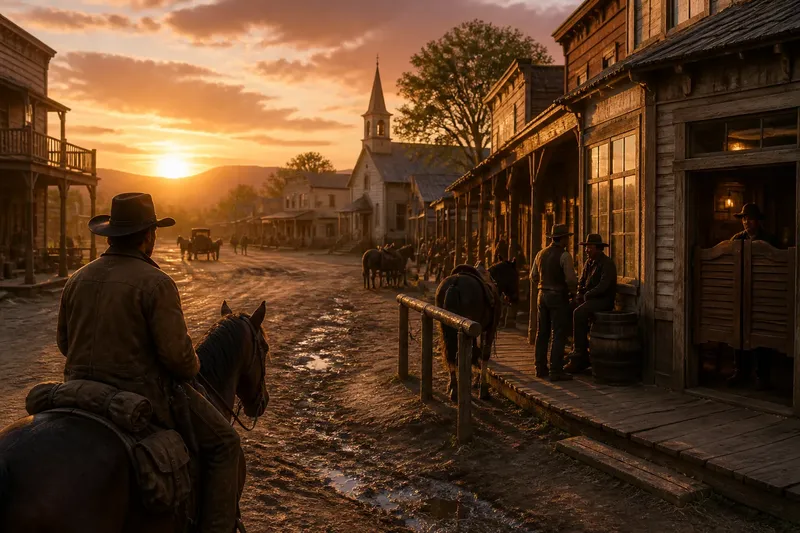
A rider reaches town at dusk, crosses a dusty street, and slows outside the storefronts. The Western town layout has already changed the story: the rider is no longer moving through open country but entering a place where paths, property, and public life have been arranged. Watch how the film marks that passage. A town can feel settled before anyone says the word “home.”
To read that change, follow the town over a morning of viewing. Begin with the street, move through the thresholds that divide public from private space, then watch where people gather. This is not a test of whether a set looks historically accurate. It is a way to notice how a film uses built space to make community visible—and how that community may still be fragile.
The Street’s Direction
Start with the main street. Is it a clear route through town, a broad space for meeting, or little more than a track between buildings? Its shape suggests what the settlement is for. A straight street lined with a general store, saloon, hotel, and stable can imply regular trade and arrivals. A road that passes through without widening or gathering may make the town feel provisional: a stop on a longer journey rather than a destination.
Look at what lies at either end of the street. A church, courthouse, rail depot, or stretch of open land can give the route a destination and a civic meaning. A building placed at the far end may appear to anchor the town, while a street that dissolves into scrub keeps the surrounding territory close. The composition can hold both ideas at once: people have organized a settlement, yet the open country remains within sight.
Then notice how the camera lets the street be used. Does a character walk its length in view, crossing past shops and neighbors, or does the film cut directly from one important doorway to another? Continuous movement makes the town legible as shared ground. Abrupt cuts can instead make it seem like a row of separate stages, each controlled by whoever occupies it.
On a first viewing, trace one route from the edge of town to its center. That route often reveals more than a wide establishing shot.
Doors and Boundaries
Thresholds show where a town’s public life ends. A porch or boardwalk extends a building’s interior toward the street. It gives a character a place to wait, watch, or address passersby without fully joining them. A swinging saloon door offers a different kind of boundary: it conceals the room, then turns entry into a brief, visible event. The movement from street to interior can feel easy, guarded, or socially charged.
Watch who crosses these boundaries without hesitation. A shopkeeper stepping onto the boardwalk to greet a customer treats the street as an extension of daily business. A stranger lingering outside a public room may be present but not yet accepted. A character who pauses at a church or courthouse door can seem to weigh the authority inside, even before speaking. Such moments make belonging a matter of access, not just residence.
Buildings also divide the town by function. The store invites exchange; the jail marks enforcement; the hotel offers temporary shelter. A film may place these buildings close together, suggesting that commerce, authority, and hospitality share a compact civic world. Or it may isolate a jail at the edge of town, making order look like something imposed from outside ordinary life.
Pay attention to who owns the threshold. A door held open by one character can welcome another, while a guarded entrance can turn a public-looking building into private territory. The town’s rules often appear first as small permissions.
Where People Gather
A settlement becomes a community when people repeatedly occupy the same places. The saloon, church, store counter, courthouse steps, and town square each offer a different kind of gathering. Some support trade or recreation; others imply shared belief or public decision. A film does not need a formal meeting to make a place communal. A few neighbors exchanging news near a hitching rail can establish a routine of recognition.
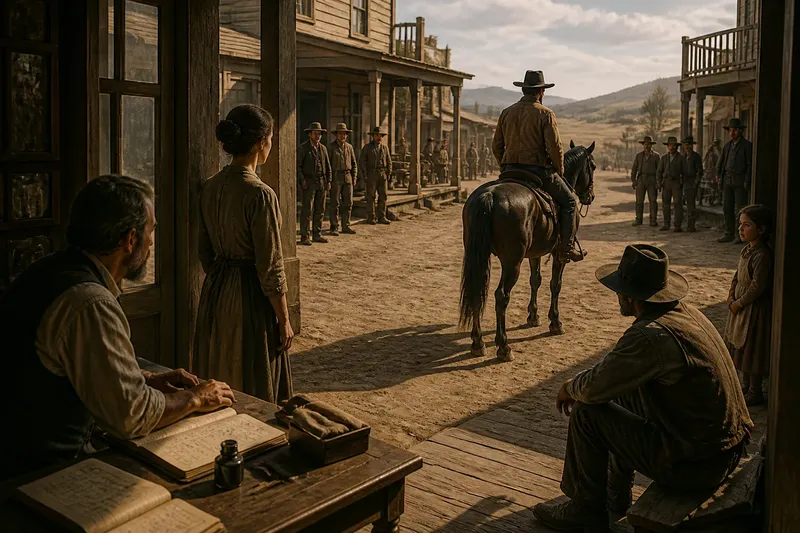
Notice the arrangement of people as well as the building. Are they gathered in a loose cluster, seated in rows, or spread along the edge of a room? A loose group can suggest informal exchange, while rows direct attention toward a speaker or ritual. If one person stands apart at the edge, the shot may show a social boundary even when the character remains physically present.
Who is missing matters, too. A saloon may be crowded while the street outside stays empty. A courthouse may fill only when conflict demands a public audience. These choices can make the town’s shared life feel ordinary, selective, or dependent on a crisis. Do not assume that a busy room represents everyone who lives there; look at whose faces the film includes and who is allowed to speak.
Gathering places make settlement visible through repetition. When the same counter or porch returns across scenes, it can function as a record of who has become familiar with whom.
A Morning Viewing Plan
Use one quiet morning to watch a Western with the town’s changing sense of order in mind. Choose a film that gives the settlement more than one appearance. Keep a page of notes, but write only what the frame shows: a street route, a doorway, a gathering place, or a change in who occupies one of them. Avoid assigning a meaning before you have seen how the space recurs.
- First pass: Watch the opening town scene without pausing. Note where the camera first places the settlement in relation to the surrounding land.
- Street pass: Replay the arrival or departure. Trace the character’s route and mark which buildings the film places along it.
- Threshold pass: Choose one entrance that recurs. Note who crosses it, who waits outside, and whether the camera shows the interior.
- Gathering pass: Find a scene in a shared room or public space. Observe who is present, who leads the exchange, and where isolated figures stand.
- Return pass: Compare a later view of the same location with the first. Look for changed occupancy, altered movement, or a new use for the space.
Say you choose an invented Western in which a rider first pauses outside the general store, then later speaks with neighbors on its porch. The first scene makes entry uncertain; the later one suggests familiarity, though it does not prove the rider has been accepted everywhere. Record the visible change—the move from watching the street to joining a conversation—and leave broader conclusions open until the film supplies more evidence.
At the end of the morning, circle the location that changed most in your notes. Ask whether the change came from the set, the camera, or the people using the space. That distinction keeps interpretation close to what is on screen.
What Does Settlement Look Like?
Why does a boardwalk matter?
A boardwalk creates a shared strip between private interiors and the street. It lets characters meet, watch, and speak without stopping inside a building, so the edge of a home or shop becomes part of public life.
What does an empty street suggest?
An empty street can make a settlement feel exposed or temporarily abandoned, but its meaning depends on the scene. Compare it with earlier and later views to see whether emptiness is routine, a sign of danger, or simply a choice of framing.
How can a town seem organized?
Repeated routes, recognizable building functions, and gathering places can make daily life feel coordinated. Notice whether characters move through those spaces as if they know the town’s habits, rather than treating every doorway as unfamiliar.
Does a larger town always feel more settled?
No. A crowded street may still feel divided if people occupy separate zones or avoid one another. A modest settlement can feel more communal when the film shows recurring encounters and shared use of its public places.
Order Without Closure
A town can organize the frontier without making it safe, fair, or permanent. A courthouse gives conflict a public address, but the film may show that access to judgment is uneven. A church can gather residents while leaving outsiders at the door. Streets and buildings make rules visible; they do not tell us that everyone accepts those rules.
This tension is part of what gives the Western town its force. The town’s geometry promises routine: a road to follow, a counter to approach, a place to meet. The surrounding country remains close enough to challenge that promise. A final shot from a porch or street corner can hold both conditions together, with the settled space in the foreground and open land beyond it.
When you return to the Western town layout in a later scene, look for the smallest sign of changed access: a door left open, a familiar figure recognized, or a gathering that no longer needs to be called. Those modest shifts show how a place becomes shared, while leaving room for the film to question who gets to belong.