The Lone Rider Myth and the Work of a Supporting Cast
The lone rider myth can hide how a Western’s supporting cast shapes loyalty, conflict, and consequence. Learn to read those roles scene by scene.
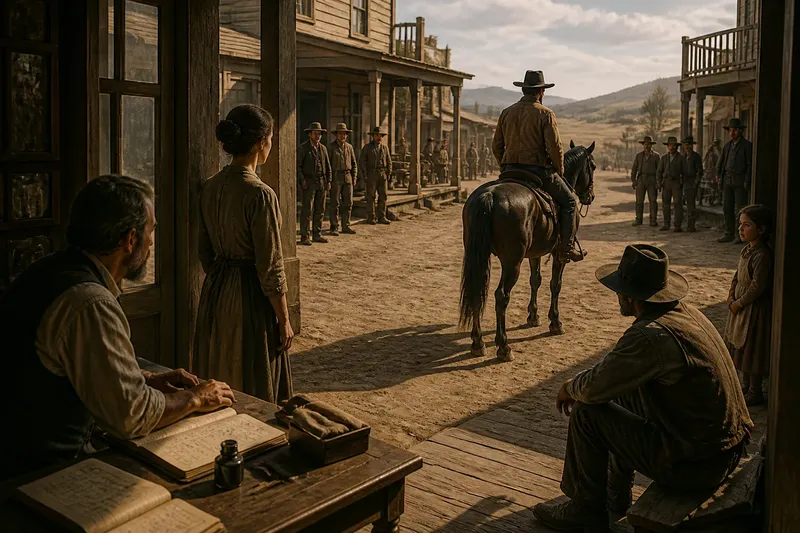
A rider reaches a dusty street, and every face turns toward him. The scene seems to belong to the man in the saddle, but the people watching have already given his arrival meaning. To read a Western beyond the lone rider myth, follow what the supporting cast wants, risks, and changes around him.
Start with the arrival
Choose a scene where the central figure enters a place, joins a group, or returns after an absence. Before asking what the hero intends, notice who is already there. A shopkeeper may pause over a ledger; a ranch hand may keep working; a child may watch from a doorway. These small actions establish that the setting has a life beyond the rider’s journey.
Write down what each person appears to be doing before the protagonist draws attention. Then ask whether the arrival interrupts, confirms, or threatens that activity. The distinction matters: a quiet street can suggest wary anticipation, while people who continue their chores may signal indifference or stubborn routine.
Keep the first pass descriptive. “The woman closes the shutters” is more useful than “the town fears him” until the scene gives you grounds for that judgment.
Map the relationships
Now identify the supporting roles by their connection to the protagonist and to one another. A deputy can be an ally, an employee, or a rival for local authority. A rancher’s family may disagree among themselves rather than act as a single unit. A saloon keeper can welcome a stranger for business while resenting the danger he brings.
Sketch a simple relationship map on paper. Put the central figure in the middle, then add names or role descriptions around him. Use a line for each visible bond—kinship, debt, work, friendship, suspicion—and mark the direction of power. Who can give orders? Who controls access to food, shelter, information, or a horse?
Say you are watching a fictional scene in which a rider asks a stable worker to saddle a horse. The worker glances toward the owner before answering. That glance gives the owner authority, makes the worker’s choice consequential, and tells you the rider cannot simply command the whole place. Track the observable behavior before assigning motives.
Read the pressure
Supporting characters often make a hero’s choices legible by bearing the costs that an individual adventure can overlook. Ask who may lose a job, a home, a family member, or the trust of neighbors if the protagonist acts. A warning from a shopkeeper may carry more weight than a speech from a lawman if the shopkeeper must remain after the rider leaves.
Notice how pressure travels through the group. A threat aimed at one person may silence several others. A public accusation can divide a room even when nobody answers aloud. Look for changes in posture, distance, work, and willingness to meet someone’s eyes. These choices can show the community’s response without turning every supporting role into a narrator.
Then compare the stated stakes with the visible ones. The hero may describe a conflict as personal, while the cast’s reactions reveal that local livelihoods and loyalties are involved. That gap is often where the story’s moral friction sits.
Questions about supporting roles?
Why do minor characters matter in a Western?
They show what the hero’s decisions mean to people who cannot simply ride away. Their work, loyalties, and exposure to danger make the story’s community visible.
How can I tell whether a character has agency?
Look for a choice that changes what happens next, even if the character has little authority. Refusing to answer, hiding a key, or speaking in public can redirect a scene.
What does a silent crowd contribute?
Silence can register fear, disagreement, caution, or a shared refusal to help. Read it alongside faces and actions rather than treating it as one uniform reaction.
Does the supporting cast always oppose the hero?
No. A character can help the protagonist while questioning his methods or protecting a separate interest. Mixed motives make cooperation feel like a relationship, not automatic loyalty.
Follow the consequences
After the central decision, return to the people who were present earlier. Did the deputy keep his post? Did the stable worker finish the task? Did neighbors begin speaking again, or did they move apart? These details show whether the action altered the group’s habits and relationships.
Separate immediate effects from longer implications. A frightened witness may give information now but become vulnerable to retaliation later. A family’s public support may leave one member isolated at home. The film may not resolve every cost, but a changed routine can make consequence visible without explanation.
Also ask who is allowed to leave the scene. The protagonist’s departure may close his part of the plot while leaving others to repair damage, settle debts, or face the next day. That contrast exposes how the lone rider story can treat mobility as freedom for one person and as a burden for everyone who stays.
Make a scene record
For a close reading, replay or recall one scene and note four things in order: who is present, what each person wants, what pressure limits each choice, and what changes by the end. Keep each entry concrete. “The deputy wants quiet” is an interpretation; “the deputy lowers his voice when the rancher enters” is an observable detail that can support one.
Use the record to test the scene’s apparent center. If the hero speaks most but another character’s decision changes the outcome, the scene’s real authority may be distributed. If the community only reacts, ask whether the film has given individuals enough distinct behavior to make that reaction meaningful.
The lone rider myth becomes easier to question when attention stays with those who remain in the frame. The next time a Western hero rides into town, follow the person who looks away, the one who keeps working, and the one who makes him wait. Their choices may explain not only what the hero can do, but what his presence costs.