Before the Movie Western: Where the Frontier Story Took Shape
Before the movie Western, frontier stories moved through dime novels, melodrama, and song. See how these forms shaped the plots and performances cinema inherited.
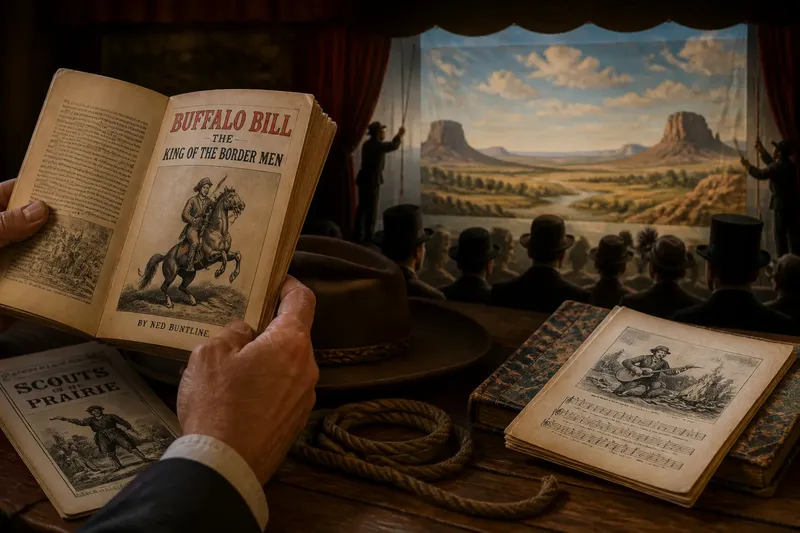
A reader opens a dime novel, while a theater audience watches a painted prairie backdrop roll into place. Long before the movie Western, frontier stories traveled through print, stage melodrama, and song. These forms did not simply pass along a fixed genre. Each offered different ways to make danger, authority, and belonging visible.
Print and the frontier story
In the decades after the Civil War, inexpensive story papers and dime novels brought tales of frontier adventure to readers far beyond the places they described. Publishers such as Beadle and Adams helped make this format familiar. Ned Buntline’s popular stories about Buffalo Bill, beginning with “Buffalo Bill, the King of the Border Men” in 1869, joined a living celebrity to the vivid, repeatable adventures of popular fiction. Such books were entertainment, not neutral records of western life.
Print made a story easy to carry and repeat. A traveler could cross unfamiliar ground, a settlement could face a threat, and a capable figure could arrive to settle a conflict. Writers varied the details while retaining a recognizable shape. The frontier became a setting for testing courage and authority, rather than a full account of the different communities and conflicts found in the West.
That compression made the stories legible, but it also narrowed their view. Adventure plots favored decisive action and clear outcomes; historical events could involve prolonged disputes, competing claims, and uncertain consequences. When reading a frontier tale, separate what it presents as exciting from what it can establish as history.
Stage melodrama in motion
Stage melodrama gave frontier conflict bodies, entrances, props, and gestures. A printed narrator could explain a character’s hesitation. Onstage, the actor had to convey it through posture, timing, or speech. Touring spectacles used scenery, costumes, sound, and staged movement to establish a frontier setting quickly, then turn attention to pursuit, rescue, or confrontation.
Buffalo Bill’s “Scouts of the Prairie,” a stage play associated with Ned Buntline, brought the celebrated scout into theatrical adventure. Later, Buffalo Bill’s Wild West combined reenactments, riding displays, and other performances in a large public spectacle. These shows were not the same as a conventional play, but they helped make frontier figures and images available to audiences as staged entertainment.
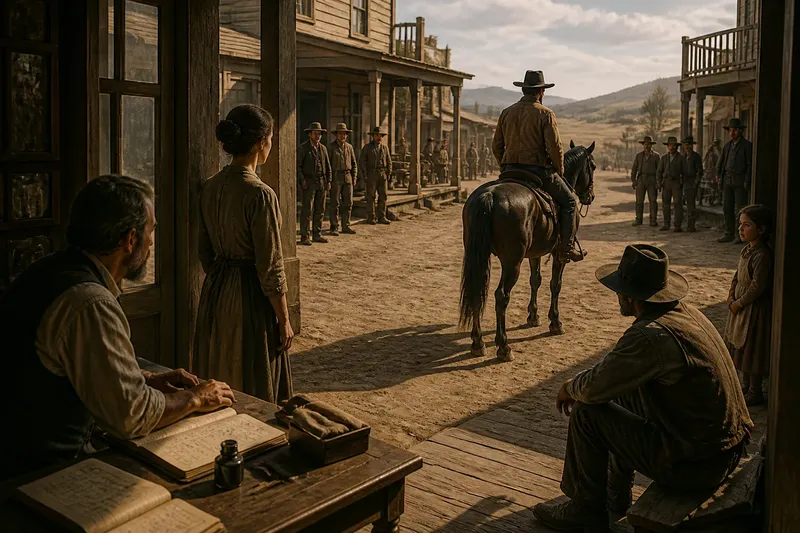
The theater’s shorthand could clarify a conflict: a blocked doorway, a sudden entrance, or a still figure facing a crowd gave viewers something immediate to read. Yet performance also left room for interpretation. An actor’s delivery could make a stern authority figure seem admirable, ridiculous, or menacing without changing the lines.
Notice what the audience must see before the next action makes sense.
Ballads and public memory
Songs and spoken anecdotes could compress an event into a memorable sequence. A ballad’s refrain made it easy to carry a story from one gathering to another; a repeated anecdote could turn one daring action into the part listeners remembered. Retelling did not automatically erase a story’s connection to events, but it could change emphasis and leave context behind.
That distinction matters when a familiar name or incident appears in a later Western. A story may preserve a community’s memory without serving as a complete record. To ask what happened, seek accounts that establish context and corroboration. To ask why a legend endured, examine its repeated images, moral choices, and omissions.
Imagine an invented account of a traveler crossing a difficult pass. Its starting point is a practical description of the route and its obstacles. In a later retelling, someone adds a daring rescue and makes that action the center of the story. The observable result is a tighter, easier-to-repeat tale, but the route’s less dramatic details no longer explain the whole event.
Tracing the frontier story?
Where should I start with the frontier story?
Begin with a specific work of popular fiction, such as a Buffalo Bill tale by Ned Buntline, and identify its danger, central figure, and resolution. Then compare those elements with another story rather than treating one plot as the genre’s blueprint.
How did stage melodrama shape Western stories?
It made conflict visible through gesture, entrances, scenery, and timing. Buffalo Bill’s “Scouts of the Prairie” offers a named point of reference for how a frontier celebrity could become a theatrical character.
How can I tell legend from historical record?
Place a retelling beside accounts that provide context, then note what has changed in motive, emphasis, and consequence. A legend can illuminate public memory, but it cannot by itself establish every detail of an event.
Which form mattered most before cinema?
No one form accounts for the Western’s inheritance. Popular print offered repeatable plots, theater made action visible, and songs or anecdotes helped carry memorable versions of events.
Compare forms directly
Follow one story ingredient across forms instead of searching for a single founding text. A journey, rescue, disputed claim, or stranger entering a troubled settlement can reveal what each medium emphasizes. Use these observations to decide what kind of claim a version is making:
- Setting: If a printed tale names places and explains the route, compare those details with what a stage scene reduces to a painted backdrop; then distinguish geographic description from theatrical shorthand.
- Central choice: If the protagonist makes a decisive choice, check whether the account explains the motives; if it does not, treat the action as a plot device rather than a complete account of character.
- Authority: If a hero’s standing comes from reputation or official position, note which the story emphasizes; if the source is unclear, avoid treating the character as a straightforward model of historical authority.
- Resolution: If the ending presents a conflict as settled, check whether it addresses the consequences; if it does not, read the ending as narrative closure, not proof that the historical dispute ended.
- Omissions: If a retelling leaves out people or circumstances present in another account, record the difference; then decide whether you are studying the event or the version remembered.
- Medium: If a stage version relies on gesture and scenery, compare those cues with a narrator’s explanations in print; if the same meaning is absent, treat the difference as adaptation rather than contradiction by itself.
Say you are tracing an invented story about a stranger entering a troubled settlement. Start with a printed version in which the narrator explains the stranger’s motives. Next, imagine a stage adaptation that replaces that explanation with a silent entrance and a pause from the other actors. Finally, imagine an oral retelling that keeps only the stranger’s intervention. The resulting comparison shows three distinct choices: print supplies motive, stage uses attention and gesture, and oral memory retains the decisive action. It does not establish that any version records a real event.
A changing inheritance
The movie Western inherited no single settled frontier story. It drew on printed plots, theatrical ways of making action legible, and memories reshaped through repetition. Those forms overlapped, but they did not make identical claims about the past.
A journey across open country might signal adventure in one telling and expose displacement in another. The recognizable ingredient can persist while its meaning changes. Before treating a frontier plot as a record, ask which form carried it, what that form made easy to show, and what it encouraged its audience to remember.
The route a story traveled is part of its history. For the frontier story, that route helps explain not only what later Westerns inherited, but also why the same familiar plot could be made to mean something different.